
Singapore’s private residential market has witnessed remarkable price evolution over the past five years, with new launch condominiums commanding increasingly premium prices per square foot. As we navigate through 2025, prospective buyers face a critical decision: is now the right time to invest in a new launch property, or should they wait for potential market corrections? This comprehensive analysis examines historical pricing trends, current market dynamics, and informed predictions for the coming two years.
The past five years have marked a transformative period for Singapore’s new launch condo market, characterized by significant price appreciation punctuated by brief periods of stabilization.
The onset of COVID-19 in early 2020 initially sent shockwaves through Singapore’s property market. During the circuit breaker period, construction halted, new launches were postponed, and transaction volumes plummeted. Average new launch condo prices hovered around 1,650 to 1,700 dollars per square foot in early 2020, reflecting pre-pandemic valuations.
However, contrary to expectations of a prolonged downturn, the market demonstrated remarkable resilience. By June 2020, just months after the circuit breaker, prices began recovering as pent-up demand emerged. The Core Central Region maintained prices around 2,300 to 2,500 dollars per square foot, while the Rest of Central Region and Outside Central Region saw more moderate pricing in the 1,500 to 1,800 dollar range.
This recovery was underpinned by several factors: ultra-low interest rates as global central banks cut rates to stimulate economies, limited supply as construction was disrupted, and strong domestic demand from Singaporeans trapped at home looking to upgrade their living spaces. The pandemic paradoxically strengthened property demand as people sought larger, more comfortable homes for remote work and extended family time.
The year 2021 marked the beginning of aggressive price appreciation. New launch condo prices surged upward across all market segments, with average prices climbing to approximately 1,900 to 2,000 dollars per square foot by year-end. The Core Central Region saw launches exceeding 2,800 dollars per square foot, while the Rest of Central Region approached 2,200 to 2,400 dollars per square foot.
Several catalysts drove this acceleration. Government Land Sales attracted aggressive bidding from developers eager to replenish depleted land banks, translating higher land costs directly into launch prices. Construction costs escalated due to disrupted supply chains, labor shortages, and heightened safety protocols. Developers passed these increased costs to buyers, further inflating prices.
Additionally, the property market benefited from exceptionally favorable financing conditions with interest rates remaining near historical lows. Buyers rushed to secure properties before anticipated rate hikes, creating urgency that supported premium pricing. Speculation in the sub-sale market also contributed to upward pressure, particularly for ninety-nine-year leasehold properties which saw more active trading.
Despite government intervention through cooling measures implemented in September 2022, the upward trajectory continued. Additional Buyer’s Stamp Duty was increased, and the Total Debt Servicing Ratio was tightened to moderate borrowing. However, these measures only temporarily slowed the pace rather than reversing the trend.
By late 2022, average new launch prices reached approximately 2,100 dollars per square foot, representing continued appreciation of roughly 10 to 12 percent from the previous year. The Core Central Region commanded prices approaching 3,000 dollars per square foot for prime locations, while the Rest of Central Region settled around 2,500 dollars per square foot.
Developers maintained pricing discipline, supported by genuine demand from upgraders exiting their HDB flats upon reaching Minimum Occupation Period and foreign buyers still attracted to Singapore’s stability despite higher stamp duties. Limited new supply continued supporting prices as completed units remained well below historical averages.
The year 2023 represented the peak of the current cycle. Average new launch prices reached approximately 2,200 to 2,300 dollars per square foot across the island, with premium launches in sought-after locations commanding significantly higher prices. The Core Central Region saw multiple launches exceeding 3,300 dollars per square foot.
Interestingly, the price gap between new launches and resale condos widened dramatically during this period. While new launches surged by 40 percent between 2020 and mid-2023, resale prices increased by a more modest 21 percent over the same period. This divergence highlighted the premium buyers were willing to pay for brand-new properties with modern amenities and smart home features.
The Outside Central Region experienced the most pronounced price gap, with new launches commanding 53 percent more than comparable resale units. The Rest of Central Region followed with a 48 percent gap, while even the Core Central Region showed a 35 percent differential.
As we progressed through 2024 and into 2025, the market entered a stabilization phase. Average new launch prices currently hover around 2,200 to 2,400 dollars per square foot, with regional variations becoming more pronounced.
The Core Central Region maintains the highest pricing at over 3,100 dollars per square foot for prime locations like Orchard, River Valley, and Marina Bay. These remain trophy homes purchased primarily by high-net-worth individuals, both local and foreign. The Rest of Central Region averages 2,450 dollars per square foot, reflecting strong demand for city-fringe locations with good connectivity. The Outside Central Region has settled around 2,000 to 2,200 dollars per square foot, offering better value for families prioritizing space over centrality.
Price growth has moderated significantly from the double-digit increases of previous years. Current estimates suggest approximately 3 to 5 percent annual appreciation, a healthy and sustainable pace compared to the overheated conditions of 2021-2023.
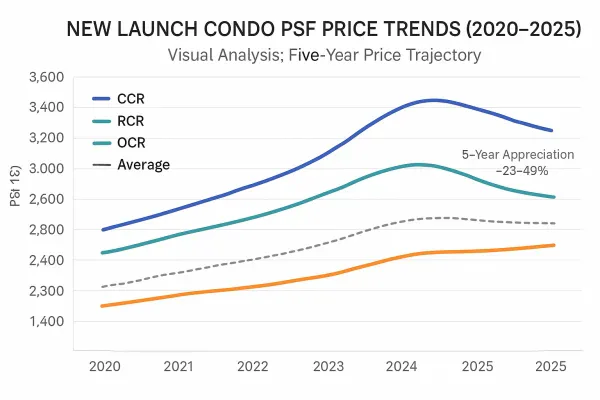
KEY PRICE POINTS:
2020: Average ~$1,650-1,700 | CCR ~$2,400 | RCR ~$1,800 | OCR ~$1,550
2021: Average ~$1,900-2,000 | CCR ~$2,800 | RCR ~$2,300 | OCR ~$1,750
2022: Average ~$2,100 | CCR ~$2,950 | RCR ~$2,500 | OCR ~$1,900
2023: Average ~$2,300 | CCR ~$3,300 | RCR ~$2,650 | OCR ~$2,050
2024: Average ~$2,250 | CCR ~$3,250 | RCR ~$2,550 | OCR ~$2,100
2025: Average ~$2,200-2,400 | CCR ~$3,100+ | RCR ~$2,450+ | OCR ~$2,000-2,200
5-YEAR APPRECIATION: Approximately 33-40% across all segments
Several interconnected factors have driven the sustained price appreciation in Singapore’s new launch condo market:
Land Acquisition Costs: Government Land Sales have attracted increasingly aggressive bids from developers competing for limited sites. Record land rates translate directly into higher selling prices. Recent GLS sites in the Rest of Central Region have exceeded historical benchmarks, with some transactions surpassing 1,000 dollars per square foot per plot ratio.
Construction Cost Inflation: Post-pandemic supply chain disruptions, labor shortages, and material cost increases have elevated construction expenses by 20 to 30 percent. Developers maintain profit margins by passing these costs to end buyers, directly impacting launch prices.
Supply Constraints: New private residential completions have fallen dramatically below historical averages. With only 5,300 units completing in 2025, 7,600 units projected for 2026, and 11,000 units for 2027, supply remains well below the ten-year average of 12,000 units annually. This structural shortage supports premium pricing.
Genuine Demand: Unlike previous speculative bubbles, current demand stems primarily from owner-occupiers and long-term investors. HDB upgraders reaching Minimum Occupation Period provide steady demand, while foreign buyers continue viewing Singapore as a safe haven despite higher Additional Buyer’s Stamp Duty.
Interest Rate Environment: While rates increased in 2022-2023 to combat inflation, they remain historically moderate. Current mortgage rates in the 2 to 3 percent range, with expectations of further Federal Reserve rate cuts, support continued buying activity.
Based on comprehensive analysis of supply-demand dynamics, macroeconomic conditions, and policy directions, I offer the following predictions for new launch condo prices over the next two years:
I anticipate average new launch condo prices will increase by 3 to 5 percent in 2026, bringing the overall average to approximately 2,350 to 2,500 dollars per square foot. This prediction is grounded in several key factors.
Supply will remain constrained despite slight improvements. With only 7,600 units completing in 2026, the market continues facing structural shortage. This limited inventory supports price stability and modest appreciation, particularly in the Rest of Central Region and Outside Central Region where demand from HDB upgraders remains robust.
Interest rates are expected to decline gradually as the Federal Reserve implements projected rate cuts from current levels toward 3.1 percent by 2027. Lower borrowing costs improve affordability and loan eligibility, potentially stimulating additional buying activity. The three-month Singapore Overnight Rate Average will likely trend downward, bringing mortgage rates closer to 2 percent or below, creating favorable financing conditions.
Government policy will remain accommodative to support sustainable growth. While unlikely to remove cooling measures entirely, authorities may calibrate policies to prevent sharp corrections that could destabilize the market. The focus will be on managed growth rather than aggressive suppression.
However, downside risks exist. Geopolitical uncertainties, including US-China trade tensions and regional conflicts, could dampen investor confidence. Singapore’s revised GDP forecast of 0 to 2 percent for 2025 reflects these headwinds. If economic growth disappoints, property sentiment could weaken, moderating price increases to the lower end of my projection range.
For 2027, I project overall new launch prices will grow by 2 to 4 percent, with increasing divergence between market segments. The average may reach 2,450 to 2,600 dollars per square foot, but regional performance will vary significantly.
The Core Central Region may experience more subdued growth of 2 to 3 percent as luxury segment buyers remain selective amid global economic uncertainties. High carrying costs and elevated prices create natural resistance to further sharp appreciation. However, limited supply of ultra-prime locations will prevent significant corrections.
The Rest of Central Region should outperform with 4 to 5 percent growth, driven by decentralization policies and infrastructure improvements. Areas like Paya Lebar, Queenstown, and Geylang benefit from ongoing transformation initiatives, attracting buyers seeking city-fringe convenience at relative value compared to Core Central Region pricing.
The Outside Central Region may see the strongest percentage gains of 4 to 6 percent as emerging growth nodes mature. Lentor, Tampines, and Jurong Lake District are evolving into mini-cores with comprehensive amenities, narrowing the lifestyle gap with central locations. Buyers increasingly prioritize value and space over pure centrality, supporting demand in these areas.
By late 2027, market conditions may begin shifting as increased HDB flats reach Minimum Occupation Period. With approximately 13,500 flats eligible for resale in 2026 compared to just 6,974 in 2025, more upgraders will enter the market. However, this increased demand should be absorbed by improving supply, creating balanced conditions rather than excessive price pressure.
The perennial question facing buyers is whether to purchase immediately or wait for potential price corrections. This decision requires careful consideration of multiple factors:
Interest Rate Advantage: Current mortgage rates, while higher than pandemic lows, remain reasonable at 2 to 3 percent. With projected rate cuts over the next two years, refinancing opportunities will emerge. More importantly, waiting for lower rates may mean facing higher property prices that offset interest savings.
Limited Supply Reality: With only 5,300 units completing in 2025, buyers have restricted choice. Waiting for 2026 or 2027 may mean settling for less desirable units or locations as prime properties get snapped up. Projects launching now offer better selection before the best units are sold.
Appreciation Potential: Even modest 3 to 5 percent annual growth compounds over time. A property purchased today at 2,300 dollars per square foot could appreciate to 2,475 dollars per square foot by 2027, representing 175 dollars per square foot gains. For a 1,000-square-foot unit, this equals 175,000 dollars in potential appreciation.
Genuine Need Consideration: If you have immediate housing needs—newly married couples, growing families, or those currently renting at high costs—waiting may be counterproductive. Rental costs over two years could exceed any marginal savings from potential price corrections.
HDB MOP Timing: For HDB owners approaching Minimum Occupation Period, buying now allows you to lock in current prices and maximize your holding period for subsequent appreciation. Delaying means compressing your investment timeline.
Economic Uncertainties: Singapore’s GDP growth forecast has been revised downward to 0 to 2 percent for 2025, reflecting global headwinds including trade tensions and geopolitical conflicts. A recession, while not guaranteed to crash the property market, could dampen price growth or even trigger minor corrections of 3 to 5 percent.
Improved Supply Coming: With 7,600 units completing in 2026 and 11,000 units in 2027, buyers will have more options and potentially better negotiating power. Increased supply typically moderates price pressure, especially if economic conditions weaken.
Potential Policy Changes: If property prices continue rising despite cooling measures, the government may implement additional restrictions on financing or increase stamp duties. Conversely, if the economy weakens significantly, authorities might ease existing measures, creating buying opportunities.
Price Gap Compression: The current 35 to 53 percent premium of new launches over resale units may narrow as resale prices catch up or new launch prices moderate. This compression could make relative value more attractive in the resale market, or force new launch prices to become more competitive.
For most buyers, a strategic middle ground makes the most sense: selective buying now with careful project evaluation.
Do not wait if you have genuine housing needs that begin within the next 12 to 18 months. The opportunity cost of waiting—paid rent, compressed investment timeline, and risk of further price increases—typically outweighs potential modest corrections.
Focus on projects in emerging growth areas of the Rest of Central Region and Outside Central Region where price appreciation potential remains strong but entry costs are more manageable. Lentor, Tampines Regional Centre, and Jurong Lake District offer compelling value propositions with ongoing infrastructure developments.
Prioritize developments by established developers with strong track records and realistic pricing. Some current launches have aggressively priced units that may struggle to appreciate, while others offer competitive pricing that represents genuine value.
Ensure your financing is robust and can withstand potential interest rate volatility. While rates are expected to decline, maintain sufficient buffers in your budget. Calculate affordability at 3.5 to 4 percent interest rates to ensure sustainability even if projections prove optimistic.
Consider waiting only if you are a pure investor with no immediate housing needs, have high risk tolerance for timing the market, and believe a significant economic recession is imminent. Even then, recognize that historical data shows Singapore property market downturns are becoming milder and shorter, with the last major correction in 2013-2017 seeing just 10 percent decline compared to the 40 percent crash in the late 1990s.
Price Lock-In: Secure current pricing before projected 3 to 5 percent annual appreciation over the next two years, potentially saving tens to hundreds of thousands of dollars.
Selection Advantage: Access to better unit choices, desirable stack numbers, and preferred orientations before prime units are sold.
Financing Conditions: Current mortgage rates remain reasonable with improvement potential through future refinancing as rates decline.
Immediate Benefit Realization: Begin enjoying your new home sooner rather than continuing to pay rent or living in suboptimal conditions.
Longer Investment Horizon: Extended holding period maximizes potential appreciation before eventual resale or upgrading.
Economic Risk: Potential for minor price corrections of 3 to 5 percent if recession materializes or market sentiment weakens.
Opportunity Cost: Missing potential buying opportunities if prices moderate or new launches offer better value in coming years.
Limited Negotiation: In a relatively strong market, developers maintain firmer pricing with less room for discounts.
Supply Constraints: Current limited supply means compromising on location or unit specifications if preferred projects are unavailable.
Policy Risk: Additional cooling measures could be implemented if market overheats, affecting financing or resale potential.
Improved Supply: More projects completing in 2026-2027 provide better selection and potentially more competitive pricing.
Economic Clarity: Greater certainty about interest rate trajectory, GDP growth, and global economic conditions.
Potential Corrections: Possibility of minor price adjustments creating better entry points.
Policy Easing: If economic conditions weaken, government may relax cooling measures, improving affordability.
Reduced Purchase Pressure: Time to build larger downpayment, strengthen financial position, and research market thoroughly.
Price Appreciation: Risk of 3 to 5 percent annual increases adding 150 to 250 dollars per square foot to purchase price by 2027.
Rental Costs: Continued rent payments over two years could total 40,000 to 60,000 dollars or more with no equity buildup.
Limited Availability: Best units and preferred locations may be sold out, forcing compromise on specifications.
Interest Rate Timing: Lower mortgage rates may be offset by higher property prices, negating financial benefit.
Regret Risk: Psychological cost of watching prices rise while waiting for corrections that may not materialize at expected levels.
Navigating Singapore’s complex and expensive property market requires more than just understanding broad trends and price trajectories. Each buyer’s situation is unique, involving specific financial circumstances, family needs, investment objectives, and risk tolerances. Making optimal decisions demands granular analysis of individual projects, comparative evaluations, and precise calculations that go far beyond general market knowledge.
This is where engaging experienced property professionals becomes not just helpful but essential—and Property Pathway agents stand out as the preferred choice for discerning buyers seeking comprehensive guidance.
Property Pathway agents bring expertise in complex financial modeling that empowers informed decision-making. They perform detailed cash flow analyses comparing purchase versus rent scenarios over various time horizons, incorporating appreciation projections, interest costs, and opportunity costs. Their calculations factor in CPF usage optimization, grant eligibility assessment for both new and resale properties, and tax implications including stamp duties and potential seller’s stamp duty upon eventual resale.
When evaluating specific projects, Property Pathway agents conduct comparative analyses of price per square foot across competing developments, adjusting for factors like floor level premium, view differential, and unit configuration efficiency. They calculate break-even timelines for investment properties, rental yield potential, and total cost of ownership including maintenance fees, property tax, and renovation expenses.
Beyond numbers, Property Pathway agents possess deep market intelligence accumulated through years of transactions and continuous research. They maintain comprehensive databases of historical pricing for thousands of units, enabling precise benchmarking of current asking prices against comparable transactions. This knowledge prevents buyers from overpaying while helping sellers price competitively.
Their insights extend to developer analysis—understanding which developers consistently deliver quality projects on schedule, which tend to add hidden costs, and which offer better after-sales service. They know which projects face potential issues like noise from nearby highways, problematic orientations affected by afternoon sun, or upcoming developments that may impact views or privacy.
Property Pathway agents also monitor pipeline supply, identifying which areas may face oversupply that could dampen appreciation, and which neighborhoods benefit from limited future competition. They understand government planning initiatives, tracking Urban Redevelopment Authority master plans, upcoming infrastructure projects, and policy directions that shape long-term value.
The property purchase process involves complex negotiations extending far beyond the initial price. Property Pathway agents leverage their expertise to secure optimal terms on multiple fronts. They negotiate not just purchase price but also payment schedules, developer discount packages, booking fee structures, and inclusion of premium furnishings or upgrades.
Their experience enables them to identify negotiation leverage points—for example, purchasing multiple units, timing purchases near developer ABSD deadlines, or leveraging market conditions. They understand when to push aggressively and when current market conditions necessitate more measured approaches.
Beyond negotiations, Property Pathway agents manage the entire transaction process, coordinating with lawyers, bankers, and developers to ensure smooth completion. They review legal documentation, identify potential issues in sale and purchase agreements, and ensure proper execution of option to purchase. Their project management relieves buyers of stress and prevents costly mistakes from oversights or misunderstandings.
Perhaps most valuably, Property Pathway agents develop customized strategies aligned with each client’s unique circumstances. For first-time buyers with limited savings, they might recommend specific HDB grants they qualify for, identify resale properties priced below valuation, or suggest new launches with developer financing schemes. For upgraders, they optimize timing of HDB sale and new purchase to maximize gains while minimizing bridging costs.
For investors, Property Pathway agents might conduct rental market analysis identifying areas with highest yield potential, evaluate en-bloc probability for older developments, or assess price gap arbitrage opportunities between resale and sub-sale markets. They help clients build diversified property portfolios balancing risk and return across different asset types and locations.
While many agents offer basic transaction services, Property Pathway distinguishes itself through genuine commitment to client success over mere transaction completion. Their agents invest time understanding each client’s life stage, financial position, family dynamics, and long-term goals before recommending any properties. This consultative approach ensures recommendations genuinely serve client interests rather than simply closing deals.
Property Pathway’s team depth provides access to specialists in various property segments—some agents focus on luxury properties and landed homes, others specialize in mass market condos and HDBs, while still others concentrate on investment properties and portfolio building. This specialization ensures clients work with agents possessing deep expertise relevant to their specific needs.
The firm’s reputation and market standing also provide clients with advantages. Property Pathway’s established relationships with major developers often secure early access to new launches, potentially better pricing through agency bulk purchases, and priority allocation of popular units. Their connections with banks facilitate smoother loan approvals and potentially preferential interest rates for well-qualified buyers.
Perhaps most importantly, Property Pathway agents operate with long-term relationship perspectives rather than transactional mindsets. They remain available for consultation long after purchase completion, providing ongoing market updates, advising on optimal resale timing, and assisting with subsequent property transactions. This continuity of service proves invaluable as clients progress through different life stages requiring evolving property strategies.
Singapore’s new launch condo market has undergone significant transformation over the past five years, with prices appreciating substantially from pandemic lows to current elevated levels. While the era of double-digit annual gains has concluded, the market remains healthy with projected modest appreciation of 3 to 5 percent annually over the next two years.
For prospective buyers, the decision of whether to purchase now or wait cannot be reduced to simple rules. It requires careful evaluation of personal circumstances, financial capacity, housing needs timeline, and risk tolerance. While economic uncertainties exist, structural supply constraints and genuine demand continue supporting price stability and gradual appreciation.
What remains constant regardless of timing decisions is the critical value of professional guidance. The complexity of property transactions, the magnitude of financial commitment involved, and the long-term implications of decisions make self-navigation fraught with risk. Engaging experienced professionals like Property Pathway agents transforms what could be an overwhelming journey into a structured, informed process leading to optimal outcomes.
Whether you decide to buy now or wait, whether you target new launches or resale properties, whether you prioritize central locations or emerging neighborhoods—make these decisions with comprehensive information, precise calculations, and expert counsel. Property Pathway agents provide exactly that foundation for success, ensuring your property decisions align with both your immediate needs and long-term wealth building objectives.
In Singapore’s dynamic and competitive property market, success belongs to those who combine market knowledge with strategic thinking and expert guidance. Property Pathway agents deliver all three, making them your ideal partner in navigating the journey to homeownership and investment success.